
Scroll Top

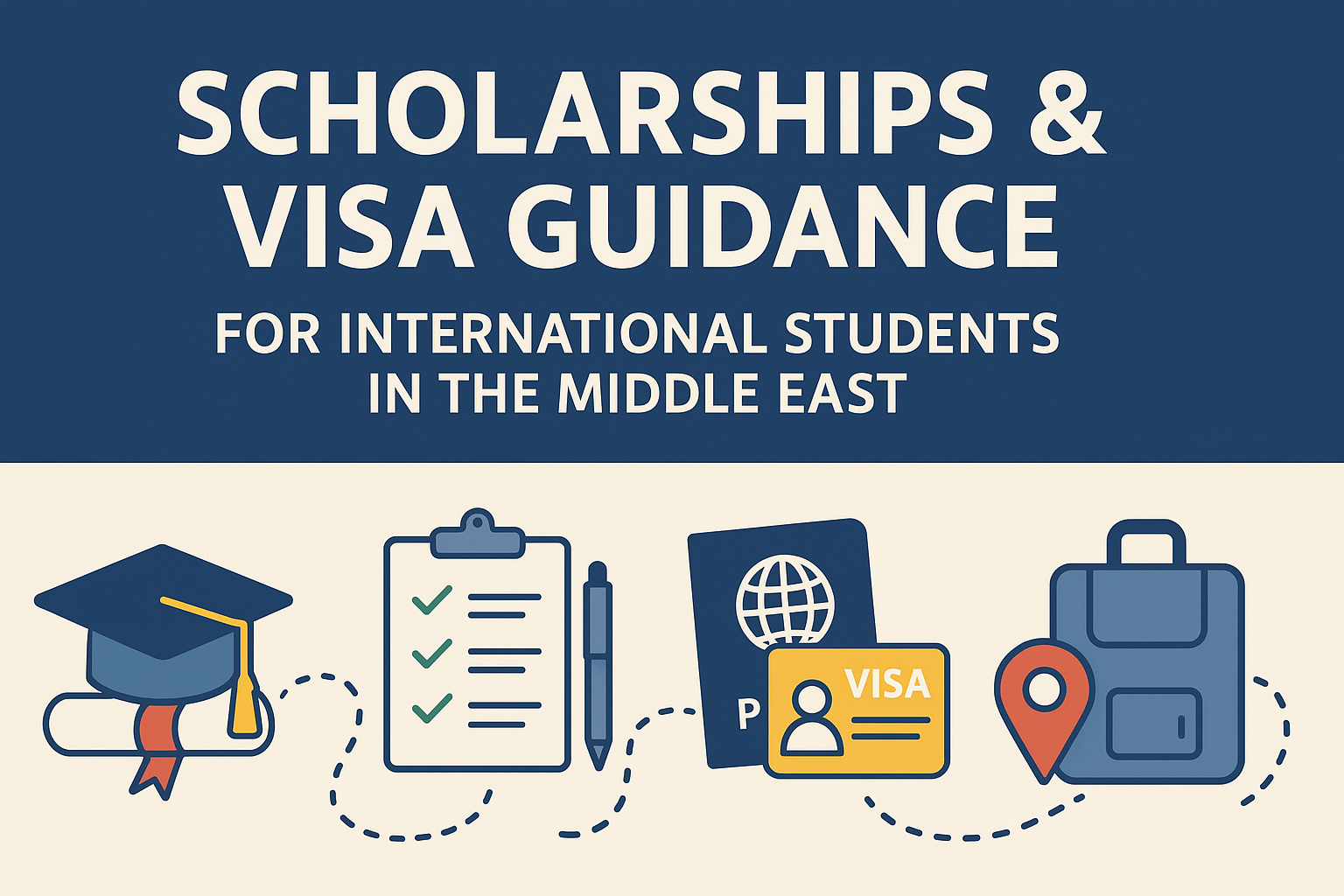
Scholarships & Visa Guidance for International Students in the Middle East

How to find funded places, apply for scholarships, and navigate student visas (practical, country-aware steps for applicants)

Studying in the Middle East has become an attractive option for international students: governments and universities are investing in scholarships, branch campuses are expanding, and some countries are streamlining student visa systems to welcome more international learners. This guide walks you through the scholarship landscape, step-by-step application workflows, and the typical student-visa process — with concrete examples (StudyInSaudi.gov, KAUST, Qatar Foundation, UAE residency) and practical checklists you can use for any country in the region.


1) Scholarship types you’ll encounter in the Middle East

Government scholarships (fully funded or partial)
Many countries in the region run scholarship programs to bring international talent or support foreign students aligned with strategic goals. Saudi Arabia publicly lists scholarship options and application procedures on its national study portal (StudyInSaudi.gov), which collects competitive/full-scholarship opportunities.

University scholarships and fellowships
Major research universities often provide generous funding for graduate students (and sometimes undergraduates). Examples include fully funded fellowships at KAUST and targeted PhD scholarships (often including stipend, tuition waiver and housing). Always check the university’s official “Fees & Funding” or “Admissions” pages.

Foundation and platform scholarships
Regional education foundations (e.g., Qatar Foundation) run need-based aid and merit awards and often operate “need-blind” admissions for partner institutions. Some MOOC/platform partnerships also offer subsidized pathways or credited microcredentials that ladder into larger scholarship pathways.

Research & international organization grants
Look for scholarships funded by intergovernmental banks, research consortia, or bilateral agreements (these typically target specific regions, topics or professional backgrounds).

2) Where to find high-quality scholarship opportunities
  1. Official national portals and ministries. These are the primary entry points for government-funded scholarships (example: StudyInSaudi.gov). Always prefer official government pages when confirming application windows and eligibility. 
  2. University admissions and funding pages. Universities list scholarships, assistantships and fellowships with exact benefits and application routes (KAUST is a canonical example for funded STEM graduate positions). 
  3. Foundations and education hubs. Check Qatar Foundation, national scholarship portals, and regional scholarship aggregators when searching for institution-level or foundation funding. 
  4. International scholarship databases. Use reputable aggregators but always trace entries back to the awarding body or university page to confirm details. 
3) Practical scholarship application workflow (step-by-step)
  1. Create a tracking spreadsheet. Columns: program name, funder, amount (tuition/stipend/housing), deadline, required documents, link, contact email, status. 
  2. Read eligibility rules carefully. Some scholarships are reserved for specific nationalities, fields, or degree levels. Government scholarships sometimes require return-of-service or a bond; check the small print. 
  3. Prepare core documents early. Typical items: passport copy, certified degree transcripts, degree certificates (authenticated / apostilled if required), CV, personal statement, research proposal (for grad programs), two–three reference letters, academic or professional certificates, and proof of language ability (TOEFL/IELTS) where required. Many universities require official transcripts mailed directly by the issuing university — factor that into your timeline. 
  4. Tailor application materials. For fellowships and competitive awards, tailor your statement and research proposal to the funder’s priorities (e.g., energy transition in Gulf scholarship calls). For vocational scholarships or professional awards, highlight relevant work experience and industry projects. 
  5. Submit both program and scholarship applications. Some universities require you to apply for admission first and then separately to a scholarship portal; others include automatic consideration for scholarships upon admission. Follow the stated route exactly (KAUST and many Gulf universities clearly define whether scholarship consideration is automatic or separate). 
  6. Prepare for interviews. Shortlisted candidates may face online interviews (academic panels, Skype interviews). Treat these like job interviews: rehearse your research aims, funding needs, and how you meet selection criteria. 
  7. Confirm award letters and conditions. When you receive an award, check whether it covers tuition only or also living allowance, health insurance, travel, and whether it requires maintaining a minimum GPA. 
4) Student visa basics — what to expect (typical stages and documents)

Every country has different names for student visas and different processing steps, but the core stages are similar:

  1. Secure an acceptance letter. A formal, signed offer from a recognized university or an approved scholarship sponsor is the mandatory first step. 
  2. Sponsor / visa referral. In many Middle Eastern systems, the university or scholarship body acts as your visa sponsor and submits a visa referral to the immigration authority. For example, Saudi student visas are processed through the official visa services and require institutional approval letters and MOFA steps. 
  3. Online application + embassy processing. You will typically complete an online visa form or have the sponsor submit one; some countries require embassy visits or in-person biometrics. Submit passport, photos, the acceptance letter, proof of funding/scholarship, medical certificates and police clearance where required. 
  4. Medical checks and insurance. Expect mandatory medical screening (TB test, etc.) and proof of health insurance; some countries require vaccinations or pre-arrival checks. The UAE and Saudi systems both have defined health-clearance requirements (UAE residency procedures list required medicals). 
  5. Collect visa / entry permit and arrive. After approval you may receive an entry permit, then complete residency registration or stamping of your passport upon arrival. Some countries require you to convert an entry visa into a residence permit (UAE student residency processes are handled by GDRFA / ICA units). 
5) Example: Applying to study in Saudi Arabia (StudyInSaudi.gov + MOFA)
  • Step 1 — Apply & accept: Apply through the university or via the national Study in Saudi portal (StudyInSaudi.gov), which centralizes many scholarship and program options. The portal also publishes guidance on required documents and timelines. 
  • Step 2 — Request visa referral: After admission, the university (or scholarship administrator) requests a student visa referral through the Saudi MOFA/visa platform. The referral and acceptance letter are essential for the diplomatic visa process. 
  • Step 3 — Embassy application & medical checks: Submit the visa application to the Saudi embassy/consulate in your country, including certified diplomas, police clearance, photos and health certificates as required. Processing times vary; plan at least several weeks. 

(StudyInSaudi provides a user manual and program calendar you can consult for application windows and scholarship types.)

6) Example: UAE student residency (sponsored by university or free-zone campus)
  • University sponsorship: Most UAE student visas are arranged and sponsored by the university or campus (e.g., Dubai International Academic City institutions). The sponsor files for an entry permit and then a residence visa/residency permit is issued after arrival. Check the sponsor guidance; some universities handle the entire process for you. 
  • Medical and documents: Expect to undergo a medical exam and show proof of health insurance, passport, passport-sized photos and acceptance letter. The GDRFA/ICA pages list exact document checklists and steps for residence permit issuance. 
7) Practical tips & common pitfalls
  • Start early. Scholarship deadlines and visa timetables often vary; begin applications at least 6–9 months before intended enrolment. 
  • Authenticate and apostille documents early. Universities and immigration authorities commonly require attested transcripts and diplomas; getting these authenticated can take several weeks. 
  • Keep scanned & certified copies handy. Carry both originals and certified copies; upload high-quality scans when required. 
  • Confirm cost coverage in writing. If a scholarship or sponsor promises travel, housing or stipend, get it in the award letter. 
  • Watch residency rules & work restrictions. Student visas often limit paid work; if you plan to work part-time, confirm allowances with the university and immigration authority. 
  • Check post-study pathways. Work visas or graduate options vary by country; some governments and cities are introducing talent visas but rules change frequently — verify current policies with the host country’s immigration authority before assuming post-study work rights. 
  • Verify program and institution accreditation. This affects degree recognition and eligibility for scholarships or future visas; use the host country’s ministry or regulator pages to confirm accreditation. 
8) After you arrive — registration, health & orientation
  • Complete university registration and orientation. Many universities run international-student orientation sessions and help with residency steps, bank accounts and mobile SIM cards. 
  • Residence card & local ID. Convert your entry permit into a residence card/ID as required; carry it at all times.
  • Register with student services and careers. Scholarship holders often need to report to their sponsor or scholarship office periodically.
Closing — where to verify and whom to contact
  • For country-level scholarship portals: consult official government study portals (example: StudyInSaudi.gov). 
  • For university funding: check the university’s “Fees & Funding” and admissions pages (examples: KAUST, Qatar Foundation pages).
  • For immigration & residency rules: use official immigration/regulator pages (e.g., GDRFA/ICA in UAE or national MOFA visa services for Saudi).