

Scroll Top

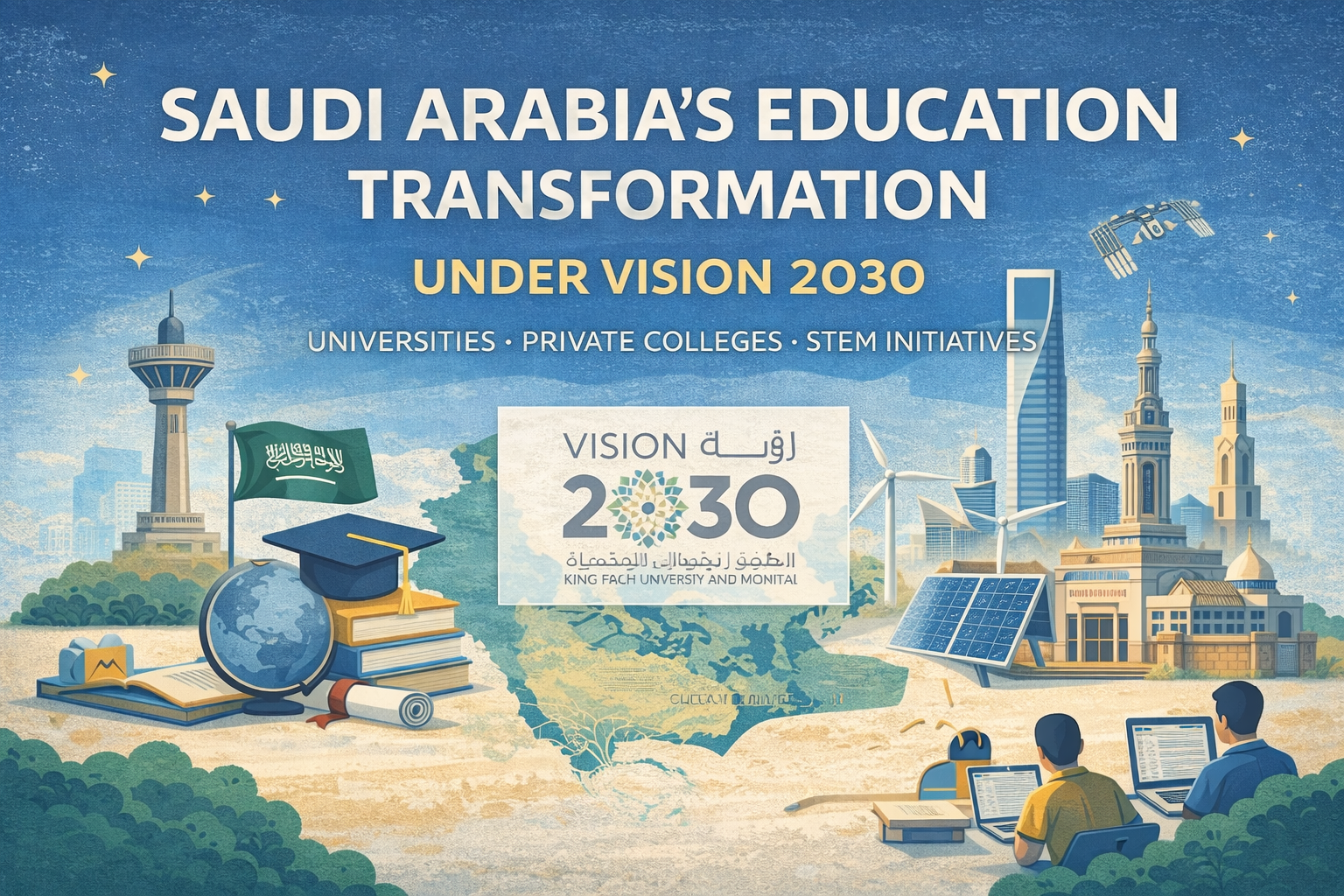
Saudi Arabia’s Education Transformation Under Vision 2030

Universities, private colleges, and STEM initiatives are reshaping the Kingdom’s future

Saudi Arabia is undergoing one of the most ambitious education reforms in the world. Driven by Vision 2030, the Kingdom aims to transform its universities, expand private higher education, and position science and technology at the core of its knowledge economy. Higher education is no longer seen simply as a public service—it is a strategic engine for economic diversification, innovation, and global competitiveness.

This transformation touches every level of education, but universities are at the center of the national strategy. From world-class research institutions to new private colleges and foreign branch campuses, Saudi Arabia is building a higher-education ecosystem designed to prepare a new generation for a post-oil economy.

This article explores the key pillars of Saudi Arabia’s education transformation: Vision 2030 universities, private sector expansion, and STEM-focused initiatives.

1. Vision 2030 and the transformation of Saudi universities

Education as a pillar of national development

Saudi Arabia’s Vision 2030 identifies education as a cornerstone of sustainable economic growth and human-capital development. The plan aims to modernize curricula, improve learning outcomes, and align academic programs with labor-market needs.

One of Vision 2030’s core objectives is to build a knowledge-based economy driven by innovation and technology, requiring a strong higher-education system capable of producing skilled graduates in science, engineering, business, and emerging fields.

The government has set ambitious targets, including positioning Saudi Arabia among the top global education systems and improving research productivity, international rankings, and graduate employability.

Governance reforms and university autonomy

Saudi universities have been undergoing structural reforms, including changes in governance, funding models, and partnerships with industry. Vision 2030 encourages universities to collaborate with private companies, research institutions, and international partners to ensure graduates possess industry-relevant skills.

Recent policy analyses highlight a shift toward decentralized governance, industry-aligned curricula, and digital learning frameworks, reflecting global trends in higher education modernization.

Aligning universities with labor-market needs

Historically, many graduates in the Kingdom entered the public sector. Vision 2030 aims to rebalance this by aligning academic programs with private-sector needs and emerging industries such as renewable energy, AI, tourism, and biotechnology.

Saudi universities are increasingly introducing applied degrees, cooperative training, internships, and industry-sponsored research projects to ensure graduates are workforce-ready.

2. Expansion of private universities and international partnerships

Growing private-sector involvement

Vision 2030 strongly emphasizes private-sector participation in education. The Ministry of Education seeks to attract private investors and foreign institutions to enhance competitiveness and diversify educational offerings.

Privatization policies in higher education are intended to increase innovation, improve quality, and expand capacity as student demand grows.

Saudi Arabia’s higher-education system is expected to grow significantly by 2030, with millions of additional students requiring new campuses, programs, and faculty.

New private colleges and universities

In recent years, the Kingdom has witnessed rapid growth in private universities and colleges offering programs in business, engineering, computing, medicine, and creative industries. These institutions often adopt international curricula, English-medium instruction, and flexible learning models.

Private universities focus on:

  • Business and management 
  • Computer science and AI 
  • Engineering and applied sciences 
  • Health and life sciences 
  • Design, media, and creative industries 

The rise of private institutions has increased competition and broadened options for domestic and international students.

Foreign branch campuses and global partnerships

Saudi Arabia is also opening its doors to international universities. Foreign branch campuses and joint programs are becoming a strategic priority to transfer global academic standards into the Kingdom.

For example, international universities are planning or launching campuses in Saudi Arabia as part of Vision 2030, reflecting growing demand and internationalization of higher education.

These partnerships allow Saudi students to earn globally recognized degrees without leaving the country while attracting international students to Saudi campuses.

3. STEM education as a national priority

Why STEM matters for Saudi Arabia

STEM (science, technology, engineering, and mathematics) is central to Saudi Arabia’s economic transformation. Vision 2030 explicitly calls for expanding STEM education to prepare students for innovation-driven industries.

The Kingdom aims to move from a resource-based economy to a knowledge-based economy, making STEM skills critical for national competitiveness.

University STEM programs and research hubs

Saudi universities are expanding STEM faculties and research centers in fields such as:

  • Artificial intelligence and data science 
  • Renewable energy and sustainability 
  • Robotics and advanced manufacturing 
  • Aerospace and defense technologies 
  • Biotechnology and health sciences 

Institutions such as King Saud University, King Abdulaziz University, and King Fahd University of Petroleum & Minerals are strengthening research infrastructure, industry collaboration, and graduate training in STEM fields.

National AI and digital-skills initiatives

Saudi Arabia is integrating emerging technologies into education at all levels. For example, the government has launched a nationwide AI curriculum initiative reaching millions of students, signaling a strategic push toward digital literacy and innovation skills.

Digital transformation initiatives include:

  • Coding and AI courses in schools and universities 
  • National digital-learning platforms 
  • Research funding for AI and robotics 
  • Partnerships with global tech firms 

These initiatives aim to create a pipeline of future scientists, engineers, and digital entrepreneurs.

4. Digital transformation and e-learning in universities

Building a digital knowledge society

Saudi Arabia’s education strategy includes building a digital knowledge society through e-learning platforms, blended education, and advanced educational technologies.

Universities are deploying:

  • Learning-management systems (LMS) 
  • Virtual labs and simulations 
  • Online degrees and micro-credentials 
  • AI-powered learning analytics 

The COVID-19 pandemic accelerated these efforts, and Vision 2030 institutionalized digital learning as a long-term strategy rather than an emergency response.

Smart campuses and research infrastructure

Many Saudi universities are investing in smart-campus technologies, including IoT infrastructure, digital libraries, research supercomputing centers, and innovation labs. These investments aim to attract international faculty and students while boosting global rankings.

5. Education beyond STEM: creative and cultural universities

Vision 2030 also recognizes that a diversified economy requires creativity, arts, and humanities. The launch of new institutions dedicated to arts, culture, and creative industries demonstrates the Kingdom’s holistic approach to education.

Recent initiatives include specialized universities focused on design, media, and cultural heritage to support the growing creative economy and tourism sector.

This marks a shift from a purely technical education focus to a balanced system integrating STEM, humanities, and creative disciplines.

6. Internationalization and student mobility

Attracting international students

Saudi Arabia aims to become a global education hub, attracting students from the Middle East, Asia, Africa, and beyond. Internationalization strategies include:

  • English-medium programs 
  • International faculty recruitment 
  • Joint degrees and exchange programs 
  • Scholarships for international students 

The Kingdom’s strategic location and investment in infrastructure make it an emerging competitor to established education hubs like the UAE and Qatar.

Learning cities and lifelong education

Saudi cities are increasingly recognized for lifelong learning initiatives and community education programs, reflecting a national emphasis on continuous learning beyond formal universities.

This broader education ecosystem supports workforce reskilling and adult learning, critical for economic diversification.

7. Challenges and implementation gaps

Scaling capacity and quality

One major challenge is scaling university capacity while maintaining academic quality. Rapid growth in student numbers requires new campuses, faculty, and funding models.

Bridging the skills gap

While universities are expanding programs, aligning graduates’ skills with private-sector demand remains a challenge. Industry partnerships and internship programs are essential to close this gap.

Faculty development and research competitiveness

Saudi Arabia continues to invest heavily in faculty recruitment and research funding, but building a sustainable research culture takes time. Training local faculty and encouraging knowledge transfer are ongoing priorities.

8. What Saudi’s education transformation means for students and universities

For students
  • More program choices (public, private, international) 
  • Increased scholarships and research funding 
  • Better career alignment with emerging industries 
  • Opportunities to study in English without leaving the country 
For universities
  • Greater autonomy and industry collaboration 
  • Global competition for rankings and faculty 
  • New funding and partnership models 
  • Emphasis on innovation and entrepreneurship
Conclusion:

Vision 2030 as a blueprint for a knowledge economy:


Saudi Arabia’s education transformation under Vision 2030 represents one of the most comprehensive higher-education reform programs in the region. By modernizing universities, encouraging private and international participation, and prioritizing STEM and digital skills, the Kingdom is laying the foundation for a diversified, innovation-driven economy.

The success of these reforms will depend on sustained investment, governance reforms, and the ability to translate ambitious policy into classroom reality. However, the scale of the initiatives—new universities, AI curricula, global partnerships, and research investments—suggests that Saudi Arabia is positioning itself not only as a regional education hub but as a rising global player in higher education.

Related Articles