
Scroll Top

Learning Platforms & Tools in the Middle East

How universities use LMS, virtual labs, VR, and blended classrooms (what’s actually being used and how to evaluate it)

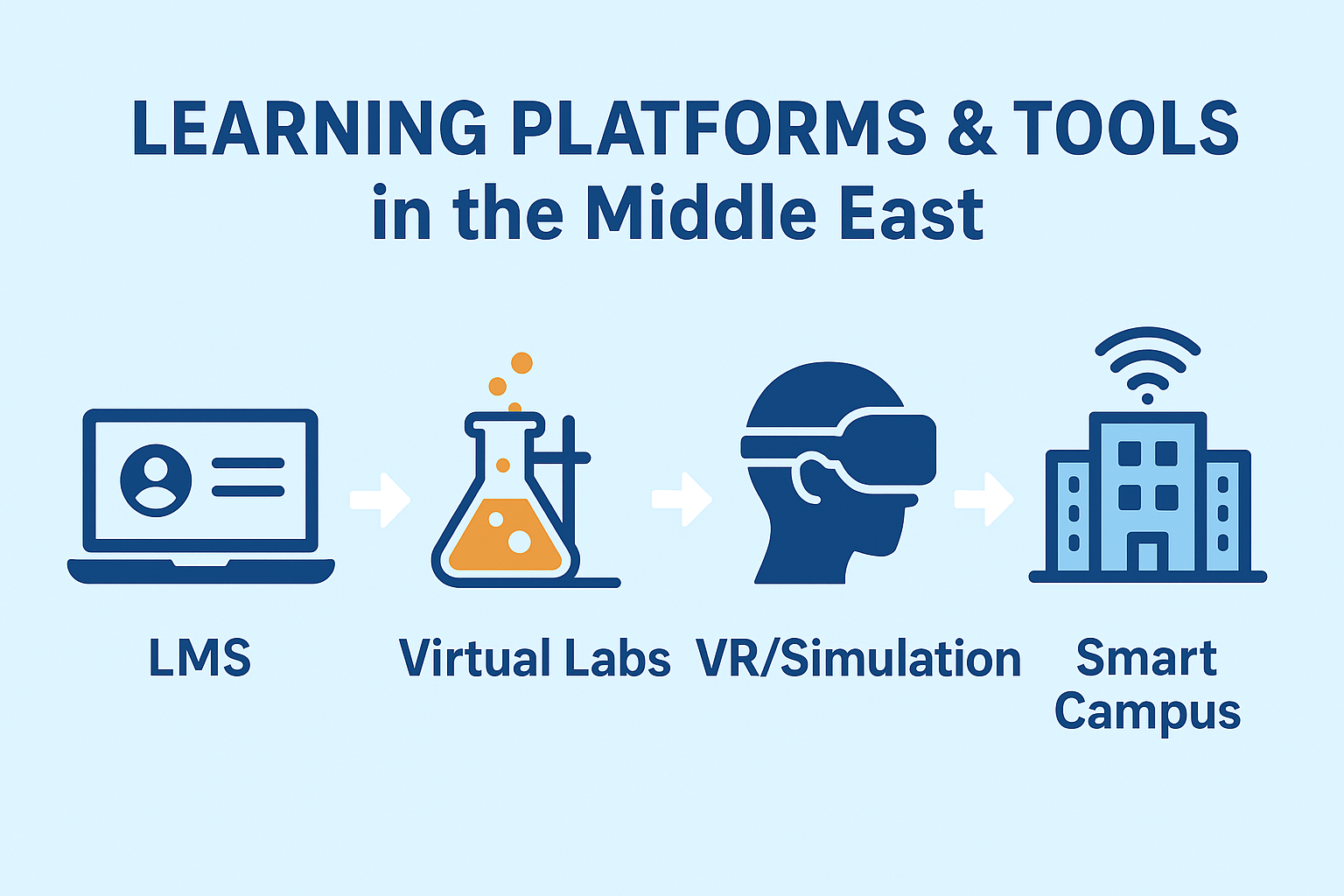
Universities across the Middle East now combine traditional classroom teaching with a growing stack of digital tools: learning-management systems (LMS), virtual labs and simulators, immersive VR/AR experiences, learning-analytics dashboards, and industry-linked sandboxes. Together, these tools enable smart campuses, scalable online degrees, and blended courses that keep lab-based training alive even when students study remotely. Below, I review the main platform types, concrete regional examples, practical benefits and limitations, and short checklists you can use when evaluating or writing about university programs.


1) The tech stack — what most regional universities actually deploy

  • Learning Management Systems (LMS) — the backbone for course delivery, assessments, and student services. Many Middle Eastern institutions implement open-source (Moodle) and commercial LMS platforms via regional partners and local integrators. Moodle has an active presence and certified partners working in the UAE and the wider MENA market. 
  • Virtual labs / science simulators — cloud-based lab simulations let students run experiments, collect data and repeat procedures safely and cheaply; vendors such as PraxiLabs and Labster are explicitly targeting universities in the region and are being adopted for STEM teaching. 
  • Immersive & simulation centers — research and teaching centres (especially at research-intensive universities) now host simulation-based learning for medicine, engineering and operations. These centres combine VR, flight/operation simulators and scenario-based training. 
  • Cloud campuses & integrated smart-campus platforms — some institutions position themselves as “smart” or “cloud” campuses where the entire student lifecycle (admissions, delivery, assessment, analytics) is digitally orchestrated. HBMSU’s Cloud Campus and Smart Campus initiatives are a clear example of that institutional model. 

(These five platform families form the practical, day-to-day tools you’ll most often find when you investigate a Middle East university’s online and blended offerings.)

2) Real regional examples — who’s doing what

  • HBMSU (Dubai) — explicitly built as a “smart university” with a Cloud Campus and Smart Campus services that run accredited fully-online and blended programs; HBMSU has published materials on online assessment design and institutional e-learning strategy. This is a strong example of an institution that coordinates LMS, virtual classrooms, and student support around a unified online-first model. 
  • Khalifa University (Abu Dhabi) — runs a Center for Experiential Learning & Clinical Simulation and a range of hands-on facilities and simulation labs that combine physical and virtual simulation for engineering and health programs. That setup shows how research universities use simulation to keep high-fidelity, applied training at the heart of STEM education. 
  • Virtual-lab providers in active use — vendors such as PraxiLabs (interactive 3D lab simulations with LMS integrations) and Labster (immersive virtual lab simulations) are marketed and deployed by multiple regional institutions and educational projects. These platforms are used to deliver repeatable, assessed lab experiences online. 

3) Why these tools matter (benefits)

  • Scale and equity: virtual labs and cloud-based course delivery allow large cohorts — including off-campus students — to access lab experiences without the constraints of physical lab space, reagent cost or safety issues. 
  • Repeated practice & assessment: simulations let students repeat experiments and receive instant feedback, which improves conceptual learning and lets instructors track mastery in detail. 
  • Integration with real-world workflows: smart-campus orchestration (admissions → LMS → analytics → employer pipelines) supports stackable credentials, work-based capstones and employer assessments — useful for professional and postgraduate programs. 
  • Risk reduction and cost savings: simulated experiments remove hazardous or costly elements from early training, allowing institutions to reserve physical labs for advanced or capstone work. 

4) Common limitations and real-world caveats

  • Not a full replacement for physical labs: high-fidelity virtual labs are powerful, but many advanced experiments, tactile skills, or certain instrument training still require physical facilities and supervised EHS (environment, health & safety) training. Khalifa University, for example, still integrates EHS and on-site lab access for practical work. 
  • Implementation & faculty training: effective blended learning requires teacher training, LMS customization, and local support teams — otherwise students face poor navigation, weak assessments, and low completion rates. Regional Moodle partners and local edtech firms often provide that implementation capacity. 
  • Quality assurance & assessment integrity: online assessment needs proctoring strategies and strong instructional design to avoid being shallow. Institutions that succeed publish clear policies and supported assessment approaches. HBMSU, for instance, documents assessment and online-learning policies for its Cloud Campus. 

5) How to evaluate a university’s e-learning tech (quick checklist for your blog posts)

For editors / program-writers

  1. Platform names & integrations: which LMS (Moodle / Blackboard / Canvas) and which virtual-lab providers (Labster / PraxiLabs / vendor names) are used? Note whether the LMS is hosted locally or cloud-hosted. 
  2. Hands-on access policy: does the program require on-site residencies, or are all labs fully virtual? Look for explicit EHS/residency notes. 
  3. Assessment & QA: are assessments proctored? Are capstones industry-linked? Is there published placement or outcome data? 
  4. Faculty & learner support: does the school provide LMS training, 24/7 helpdesk, or a local implementation partner? (Partners and support teams are often listed on university or vendor pages.)
  5. Cost & licensing transparency: virtual-lab licenses and vendor subscriptions can add program cost — check tuition pages and vendor announcements.

For students

  • Confirm accreditation and whether online/virtual lab work counts toward your degree. 
  • Verify whether any campus residencies are required. 
  • Ask how assessments are run and whether practical skills will be tested in person or virtually.

6) Where the region is headed (short forecast)

Expect deeper vendor-university partnerships (platforms integrated into degree pathways), more university-hosted simulation centres that combine VR and cloud labs, and stronger regional implementation ecosystems (local Moodle partners, edtech vendors) that reduce friction for smaller institutions adopting blended models. Market studies also show growing investment in VR/AR, AI-powered adaptive learning and expanded LMS capabilities across the UAE and Gulf markets.