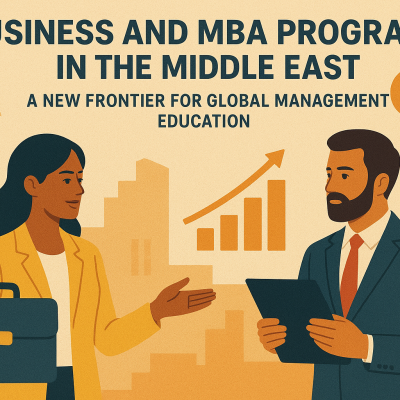

The Middle East is no longer just an energy and trade hub; it’s transforming into a powerhouse for business education. Today, universities across Egypt, the Gulf, and the Levant are attracting ambitious students who want to sharpen their leadership, entrepreneurship, and specialized skills without flying to Europe or the US. But here’s the big question: Should you choose an MBA, or would a Specialized Master’s give you a sharper edge in your career? Let’s dive in.
- Home
- Degrees Comparisons
- Best Business Schools in the Middle East: MBAs and Specialized Masters Compared (2026 Insight)
Degrees Comparisons
Best Business Schools in the Middle East: MBAs and Specialized Masters Compared (2026 Insight)
September 29, 2025
🎓 MBA Programs: Leadership and Broad Strategy
MBA programs in the Middle East mirror their Western counterparts but come with regional advantages: affordability, cultural immersion, and access to growing markets.
Where MBAs Shine in the Middle East:
- American University in Cairo (Egypt)
- Flagship MBA with regional leadership focus.
- Strong ties to multinational corporations and Cairo’s booming startups.
- American University of Beirut (Lebanon)
- Long-standing MBA tradition rooted in global business with a Levantine twist.
- Networking powerhouse for students seeking opportunities in NGOs, banking, and consulting.
- King Fahd University of Petroleum & Minerals (Saudi Arabia)
- Known for energy-sector leadership.
- MBA graduates often move directly into executive roles in oil, energy transition, and infrastructure.
- American University of Sharjah (UAE)
- Globally accredited MBA programs.
- Combines US-style business education with Gulf-market insights.
Who should choose an MBA?
- Mid-career professionals seeking management or C-suite roles.
- Those wanting a broad toolkit across finance, marketing, strategy, and leadership.
📈 Specialized Master’s: Precision Skills for Modern Markets
While MBAs are broad, Specialized Master’s degrees are laser-focused — and Middle Eastern universities are excelling here.
Popular Specialized Master’s Programs in the Region:
- German Jordanian University (Jordan) – Master’s in Logistics and Supply Chain
- Perfect for students targeting careers in trade, e-commerce, and regional logistics.
- Education City (Qatar) – Master’s in Finance (Georgetown, CMU, UCL branches)
- Offers access to global faculty with specialized finance and data analytics tracks.
- Zayed University (UAE) – Master’s in Innovation and Entrepreneurship
- Designed for startup founders and intrapreneurs riding Dubai’s innovation wave.
- Cairo University (Egypt) – Master’s in Accounting & Auditing
- Affordable, deeply rooted in regional tax and regulatory environments.
Who should choose a Specialized Master’s?
- Early-career professionals looking to fast-track expertise in one domain.
- Those who want to enter niche industries like fintech, HR analytics, or supply chain management.
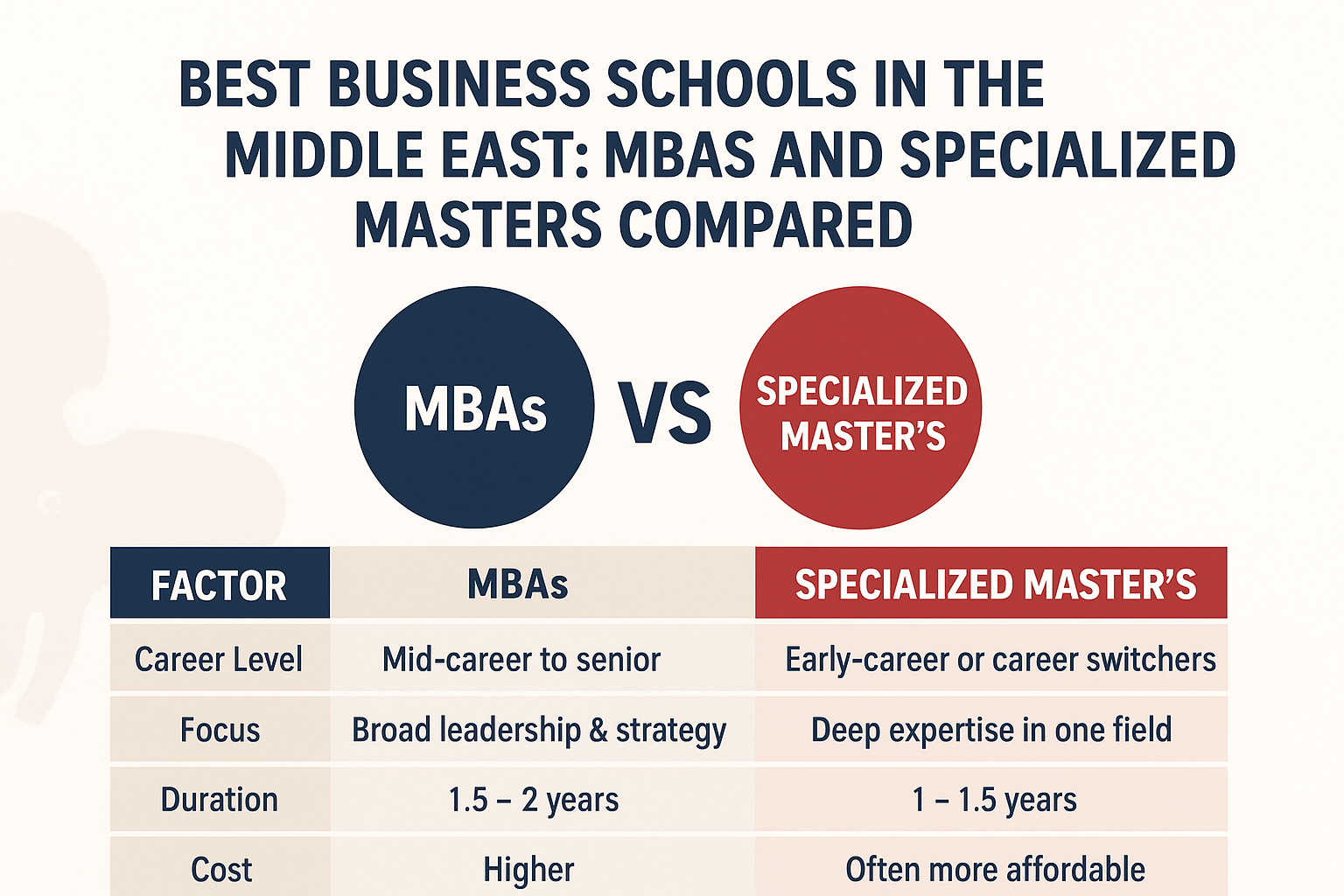
MBA vs. Specialized Master’s: Which is Right for You?
|
Factor
|
MBA
|
Specialized Master’s
|
| Career Level | Mid-career to senior | Early-career or career switchers |
| Focus | Broad leadership & strategy | Deep expertise in one field |
| Duration | 1.5 – 2 years | 1 – 1.5 years |
| Cost | Higher | Often more affordable |
| Networking | Extensive alumni & global reach | Smaller, niche networks |
| ROI (Return on Investment) | Long-term leadership roles | Faster entry into specialized markets |
Why the Middle East is Becoming a Business Education Hotspot
- Geographic advantage: Between Europe, Asia, and Africa.
- Diverse economies: Energy, tourism, finance, and tech are booming simultaneously.
- Affordable yet global: Programs cost less than US/UK MBAs but offer international accreditation.
- Government investment: Countries like UAE, Saudi Arabia, and Qatar are actively funding education reforms.
Conclusion
If you want to lead entire organizations, the MBA is your passport to C-suite and global boardrooms.
If you want to master a niche skill and stand out in a competitive job market, a Specialized Master’s could be your golden ticket.
Either way, Middle Eastern universities are no longer “alternatives”, they are now primary destinations for ambitious students from around the world.
marwan khalifa
Related Articles
Clear Filters