
Scroll Top

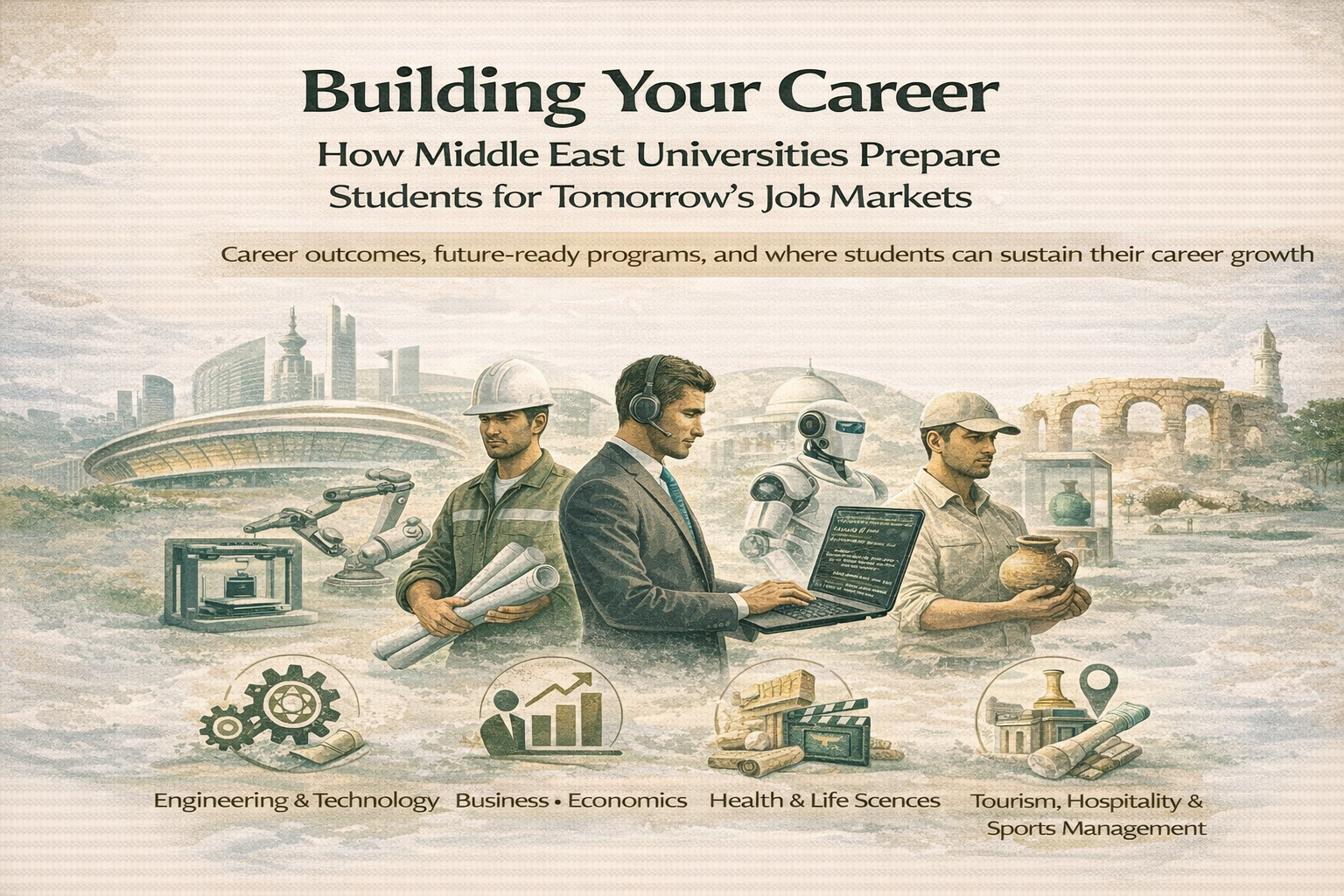
Building Your Career: How Middle East Universities Prepare Students for Tomorrow’s Job Markets

Career outcomes, future-ready programs, and where students can sustain their career growth

In today’s Middle Eastern job market, a university degree is no longer judged only by its academic reputation, but by what graduates can do on day one of employment. Employers increasingly seek candidates who understand emerging technologies, real-world challenges, and fast-evolving industries. In response, leading universities across the region are redesigning programs to align learning outcomes directly with employability. This article explores how key academic fields across top Middle Eastern universities translate into real career outcomes, with a special focus on modern learning methods, artificial intelligence integration, and industry alignment.


1) Engineering & Technology: future-ready skills for an AI-driven economy

Engineering and technology remain the strongest drivers of graduate employability in the Middle East. What sets today’s leading programs apart is not the discipline itself, but how it is delivered. Across the Arab region, top universities are moving beyond lecture-heavy models toward AI-enabled, project-based, and industry-integrated education that prepares students for rapidly evolving technological challenges.

Programs with the Top career outcomes
  • Computer Science & Software Engineering

  • Artificial Intelligence & Data Science

  • Cybersecurity & Information Systems

  • Electrical, Mechanical, and Industrial Engineering

  • Robotics, Smart Systems, and Energy Engineering

Graduates from these programs are increasingly expected to leave university with applied skills, exposure to real datasets, and experience solving real-world problems, not just theoretical knowledge.

What “modern tech learning outcomes” look like today

When evaluating leading technology programs in the Middle East, the strongest universities consistently deliver outcomes such as:

  • Project-based and capstone learning, where students design, build, and deploy real systems

  • Industry-sponsored projects, with external partners defining real technical problems

  • Hands-on cybersecurity and secure systems training, including labs and applied scenarios

  • AI and data science applied to real datasets, not simulated examples

  • Interdisciplinary engineering, combining technology with business, ethics, and human-centered design

These outcomes are increasingly what employers recognize and reward when hiring graduates.


Universities leading modern tech education across the Arab MENA

Several universities across the Middle East now stand out for embedding AI, automation, and applied problem-solving directly into their engineering and technology curricula.

United Arab Emirates: an AI-first academic ecosystem
  • Mohamed bin Zayed University of Artificial Intelligence
    Purpose-built for applied AI education, with industry-focused, project-driven curricula designed to produce AI engineers, researchers, and entrepreneurs.

  • New York University Abu Dhabi
    Known for experiential learning through mandatory year-long capstone projects that integrate technical depth with business, ethics, and societal impact.

  • American University of Sharjah
    A strong example of employability-driven engineering education, with senior design projects frequently sponsored by industry and focused on real stakeholder challenges.

  • Khalifa University
    A regional leader in AI, robotics, cybersecurity, and advanced engineering, emphasizing research-led teaching and industry-linked innovation.

Qatar: research-driven learning with industrial pathways
  • Hamad Bin Khalifa University
    Technology programs often allow students to choose between a research thesis and an industrial project, particularly in data science and cybersecurity.

  • Carnegie Mellon University in Qatar
    Offers AI programs that combine machine learning, robotics, and automated reasoning with ethics and applied project work.

Saudi Arabia: a major pillar of advanced STEM education
  • King Abdullah University of Science and Technology
    A globally oriented graduate research environment shaping high-level STEM and AI talent.

  • King Fahd University of Petroleum & Minerals
    Known for advanced AI and machine learning concentrations, including deep learning, computer vision, and applied data analytics, closely tied to industry needs.

Lebanon: interdisciplinary tech education with regional relevance
  • American University of Beirut
    Computer science programs balance theoretical foundations with applied software development and structured AI tracks.

Jordan: structured industry-linked training models
  • German Jordanian University
    A distinctive model that embeds mandatory internships and international practical training directly into engineering degrees.

  • Jordan University of Science and Technology
    Operates a dual-study approach that merges academic instruction with hands-on industry training delivered on partner sites.

Egypt: applied learning through labs and innovation ecosystems
  • The American University in Cairo
    Emphasizes supervised internships, applied research, and innovation infrastructure connecting students with industry and startups.

  • German University in Cairo
    Engineering programs require structured internships as part of graduation requirements, reinforcing workforce readiness.

Oman: capstone-driven public university models
  • Sultan Qaboos University
    Engineering programs include capstone projects designed around real economic, environmental, and safety constraints, alongside mandatory industrial training.


Why are these sustained for career growth:

These institutions emphasize:

  • Project-based AI learning: students ship applied models and prototypes, not just pass exams.

  • Capstone-as-a-proof-of-skill: a year-long capstone forces integration of engineering design, communication, teamwork, and ethics.

  • Industry-sponsored senior design: students solve external stakeholder problems, producing portfolio-ready results.

  • Industrial project option: master’s students can choose thesis or industrial project aligned with employer demand.

  • Dual study / embedded training: degree modules structured around market outcomes and delivered partly on industry sites.

Career outcomes: software engineers, AI specialists, data analysts, cybersecurity professionals, systems engineers, and R&D researchers, often with regional and global mobility.


2) Business, Management & Economics: adaptable careers across industries

Business degrees remain highly employable when paired with analytics, digital tools, and experiential learning.

Programs
  • Business Administration

  • Finance & Economics

  • Supply Chain & Operations

  • Entrepreneurship & Innovation

Notable universities
  • The American University in Cairo – strong alumni networks and employer recognition

  • American University of Sharjah – case-based learning and regional business exposure

  • Qatar University – public policy, economics, and applied business research

Career outcomes: business analysts, financial analysts, consultants, operations managers, and startup founders.


3) Health & Life Sciences: stable demand with regulated career paths

Healthcare remains one of the most secure employment sectors in the region.

Programs
  • Medicine, Nursing, Pharmacy

  • Public Health

  • Biomedical Sciences

Notable universities
  • King Abdulaziz University – teaching hospitals and clinical pipelines

  • Weill Cornell Medicine–Qatar – internationally aligned medical education

  • Jordan University of Science and Technology – applied medical and health sciences

Career outcomes: clinical practice, hospital management, research roles, and public health positions.


4) Architecture, Design & the Built Environment: careers shaped by mega-projects

Urban development and tourism projects drive sustained demand.

Programs
  • Architecture & Urban Planning

  • Interior Design

  • Construction & Project Management

Notable universities
  • King Saud University – urban planning and sustainability

  • German University in Cairo – design rigor and industry alignment

  • American University of Beirut – strong design theory and regional relevance

Career outcomes: architects, urban designers, project managers, and consultants.


5) Media, Communication & Digital Content: skills-first employability

Media careers now prioritize practical skills over theory.

Programs
  • Media & Communication

  • Digital Media & Film

  • Advertising & PR

Notable universities
  • University of Wollongong in Dubai

  • Lebanese American University

Career outcomes: content strategists, digital marketers, media producers, and communications specialists.


6) Tourism, Hospitality & Sports Management: sector-linked degrees

Tourism and sports are strategic growth sectors across the region.

Programs
  • Tourism & Hospitality Management

  • Event & Sports Management

Notable universities
  • Prince Sultan University

  • University of Dubai

Career outcomes: hotel management, event coordination, sports administration, and tourism planning.


7) Culture, Heritage & Creative Industries: emerging professional paths

Cultural investment is creating new academic-to-career pipelines.

Programs
  • Heritage Studies & Archaeology

  • Museum Studies

  • Cultural Management

Notable universities
  • Qatar University

  • University of Jordan

Career outcomes: museum professionals, heritage consultants, cultural project managers.

Conclusion:

Across the Middle East, the most employable degrees are those taught using modern methods, aligned with technology shifts, and supported by industry partnerships. Engineering and technology programs lead the way, but business, health, design, media, tourism, and culture degrees also deliver strong outcomes when universities focus on real skills, not just theory.

For students, the takeaway is clear: choose programs that anticipate future challenges, integrate AI and digital tools, and maintain close ties with employers. In today’s market, employability is built into the curriculum, or it doesn’t exist at all.