

Scroll Top

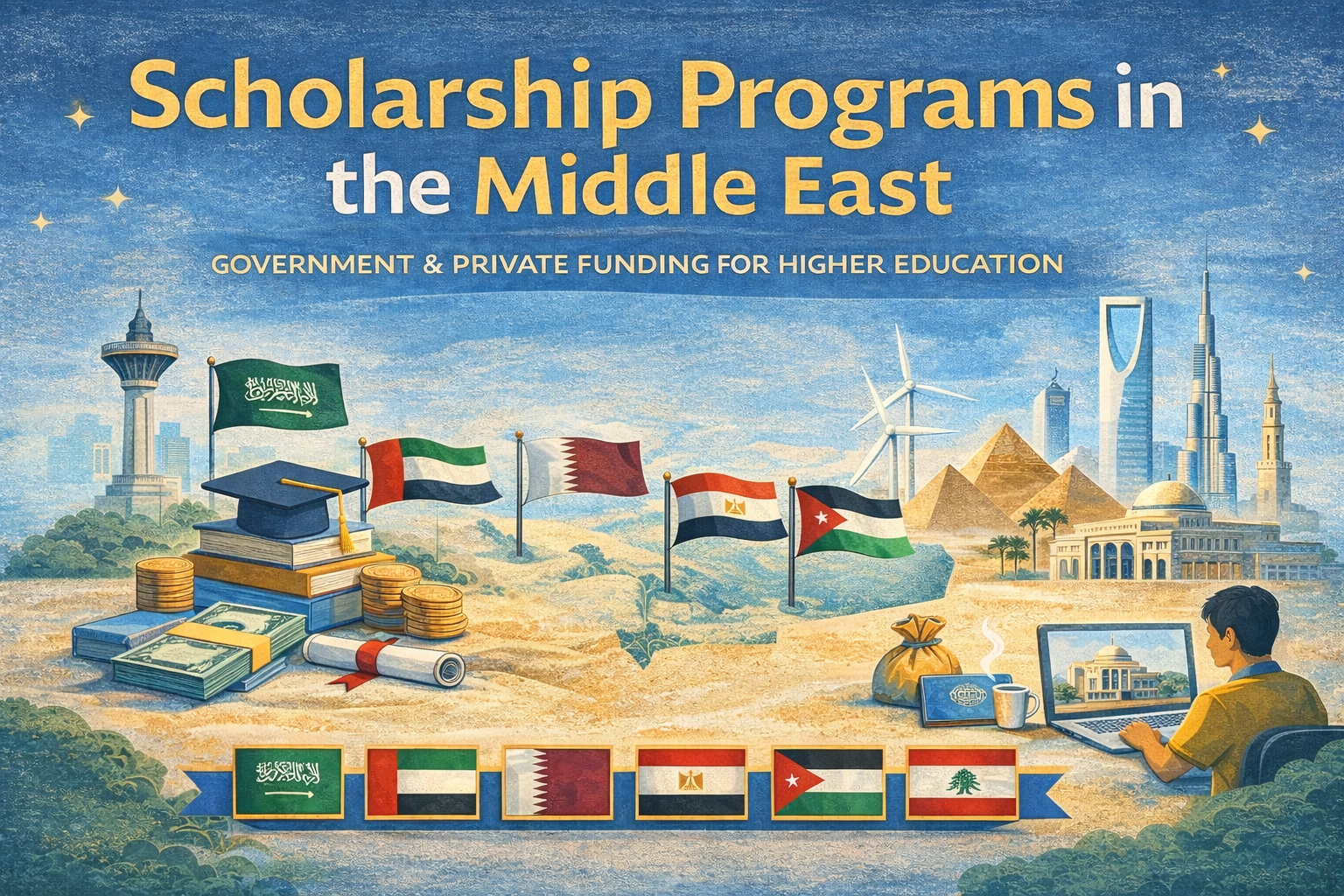
Scholarship Programs in the Middle East

Government and private funding opportunities for Higher Education

Scholarships play a central role in making higher education in the Middle East accessible to both local and international students. Over the past decade, governments across the region have significantly expanded scholarship programs as part of broader national strategies to develop human capital, attract global talent, and strengthen their universities’ international standing. Alongside public funding, private universities, foundations, and semi-government institutions now offer a growing range of merit- and need-based scholarships.

This guide explains how scholarship programs in the Middle East work, the main types of funding available, and highlights major government and private scholarship schemes by country. It is designed for students, parents, and education editors seeking a clear, practical overview of funded study opportunities in the region.


How scholarships in the Middle East typically work

Unlike many Western systems where scholarships are often fragmented or limited, Middle Eastern scholarship programs are frequently centralized, comprehensive, and fully funded, especially those sponsored by governments.

Most scholarships in the region fall into three broad categories:

  • Government-funded national scholarships
    These are usually part of long-term development plans and often cover full tuition, monthly stipends, accommodation, health insurance, and sometimes travel.

  • University-based scholarships (public or private)
    Offered directly by universities to attract high-performing students or support specific academic fields.

  • Foundation or semi-private scholarships
    Funded by charitable foundations, royal endowments, or industry-linked organizations, often targeting priority disciplines.

Scholarships are generally awarded for full degree programs (bachelor’s, master’s, or PhD), rather than short-term study.

1. Saudi Arabia: Large-scale government funding and Vision 2030 alignment

Saudi Arabia operates one of the most extensive scholarship ecosystems in the Middle East, closely aligned with its national development agenda.

Government scholarships

The flagship national program is the King Abdullah Scholarship Program (KASP). While KASP is best known for funding study abroad, it also supports students enrolled in selected Saudi universities and strategic domestic programs.

In recent years, Saudi Arabia has also launched Vision 2030–linked domestic scholarships, targeting fields such as:

  • Engineering and applied sciences

  • Artificial intelligence and data science

  • Health and medical sciences

  • Energy, sustainability, and environmental studies

These scholarships typically cover:

  • Full tuition

  • Monthly living allowance

  • Health insurance

  • Academic support and mentoring

University-based scholarships

Leading public universities such as King Saud University, King Abdulaziz University, and King Fahd University of Petroleum & Minerals offer:

  • Merit-based scholarships for top-performing students

  • Research assistantships for graduate students

  • Fully funded PhD tracks in STEM fields

Private and semi-private funding

New private institutions and specialized academies increasingly provide scholarships to attract high-achieving students, especially in business, computing, and emerging technologies. These awards often combine tuition discounts with paid internships.

2. United Arab Emirates: Merit-driven and research-focused scholarships

The UAE has positioned itself as a regional education hub, and scholarships are a key part of this strategy.

Government-supported university scholarships

One of the most prominent examples is Khalifa University, which offers some of the most generous graduate scholarships in the region.

Typical Khalifa University funding packages include:

  • 100% tuition coverage

  • Monthly stipend (especially for master’s and PhD students)

  • Accommodation or housing allowance

  • Health insurance

  • Research funding and conference support

These scholarships are highly competitive and focus heavily on:

  • Engineering

  • Computer science

  • Energy and sustainability

  • Biomedical sciences

Federal and public universities

Institutions such as the United Arab Emirates University provide:

  • Merit-based scholarships for undergraduates

  • Research assistantships for graduate students

  • Tuition waivers for outstanding international applicants

Private university scholarships

Private universities in the UAE commonly offer:

  • Partial tuition waivers (25%–50%)

  • Academic excellence scholarships

  • Sibling and alumni discounts

These are particularly common in business, media, IT, and design programs.

3. Qatar: Fully funded education through national foundations

Qatar’s scholarship system is closely tied to national foundations rather than standalone ministries.

Qatar Foundation–linked scholarships

Universities operating under the Qatar Foundation umbrella offer some of the most comprehensive funding packages in the region.

Students admitted to institutions in Education City may receive:

  • Full tuition coverage

  • Monthly stipends

  • Accommodation

  • Health insurance

These scholarships support study at internationally affiliated universities while remaining physically based in Qatar.

Public university funding

Qatar University offers:

  • Full scholarships for Qatari nationals

  • Competitive funding for international students

  • Research-based scholarships for graduate study

Priority areas include science, engineering, education, and public policy.

4. Egypt: Scholarships through public universities and private foundations

Egypt has a more decentralized scholarship system compared to Gulf countries, but still offers meaningful funding opportunities.

Public university scholarships

Major public institutions such as Cairo University and Ain Shams University provide:

  • Tuition reductions for high-performing students

  • Scholarships for postgraduate research

  • Faculty-sponsored assistantships

These scholarships are often competitive and linked to academic performance.

Private universities and foundations

Private institutions like The American University in Cairo operate robust financial aid and scholarship programs, including:

  • Merit-based scholarships

  • Need-based grants

  • Named foundation scholarships

While tuition fees are higher, scholarship coverage can be substantial for top students.

5. Jordan: Targeted funding and international-oriented programs

Jordan’s scholarship landscape emphasizes academic excellence and international engagement.

Public university scholarships

Universities such as the University of Jordan and Jordan University of Science and Technology offer:

  • Government-supported scholarships for nationals

  • Limited merit-based funding for international students

  • Research assistant roles for graduate students

Foundation and sector-based support

Jordan is notable for scholarships linked to:

  • Public policy and development studies

  • Health sciences

  • Engineering and technology

Many students combine partial scholarships with low living costs, making Jordan one of the more affordable study destinations in the region.

6. Lebanon: Merit-based support in a challenging environment

Despite economic challenges, Lebanon maintains a strong tradition of academic excellence supported by scholarships.

Universities such as the American University of Beirut provide:

  • Merit-based scholarships

  • Need-based financial aid

  • Graduate fellowships and assistantships

These programs aim to retain academic talent and support students in research-intensive fields, particularly in social sciences, medicine, and engineering.

What scholarships typically cover (and what they don’t)

Commonly covered
  • Full or partial tuition

  • Monthly living stipend (mainly government scholarships)

  • Health insurance

  • Research funding (graduate level)

Less commonly covered
  • Travel costs (except in flagship programs)

  • Family dependents

  • Visa fees (varies by country)

Students should always review scholarship terms carefully, especially renewal conditions and academic performance requirements.


How to improve your chances of winning a scholarship

Successful applicants typically:

  • Apply early and track deadlines carefully

  • Maintain strong academic records

  • Choose priority fields aligned with national goals (STEM, health, education)

  • Prepare strong motivation statements

  • Secure academic recommendations

For graduate scholarships, prior research experience is often a decisive advantage.

Conclusion: Scholarships as a strategic pillar of Middle Eastern education


Scholarship programs in the Middle East are not simply financial aid mechanisms — they are strategic tools shaping national development, workforce planning, and global academic positioning. Governments across the region are investing heavily in funded higher education to attract talent, build research capacity, and prepare graduates for knowledge-based economies.

For students, this means unprecedented access to fully or generously funded degrees at reputable universities across Saudi Arabia, the UAE, Qatar, Egypt, Jordan, and Lebanon. For universities, scholarships are a way to compete globally and elevate academic quality.

As higher education in the Middle East continues to evolve, scholarship programs will remain one of its most powerful drivers, opening doors for students who are academically prepared and strategically aligned with the region’s future priorities.