
Scroll Top

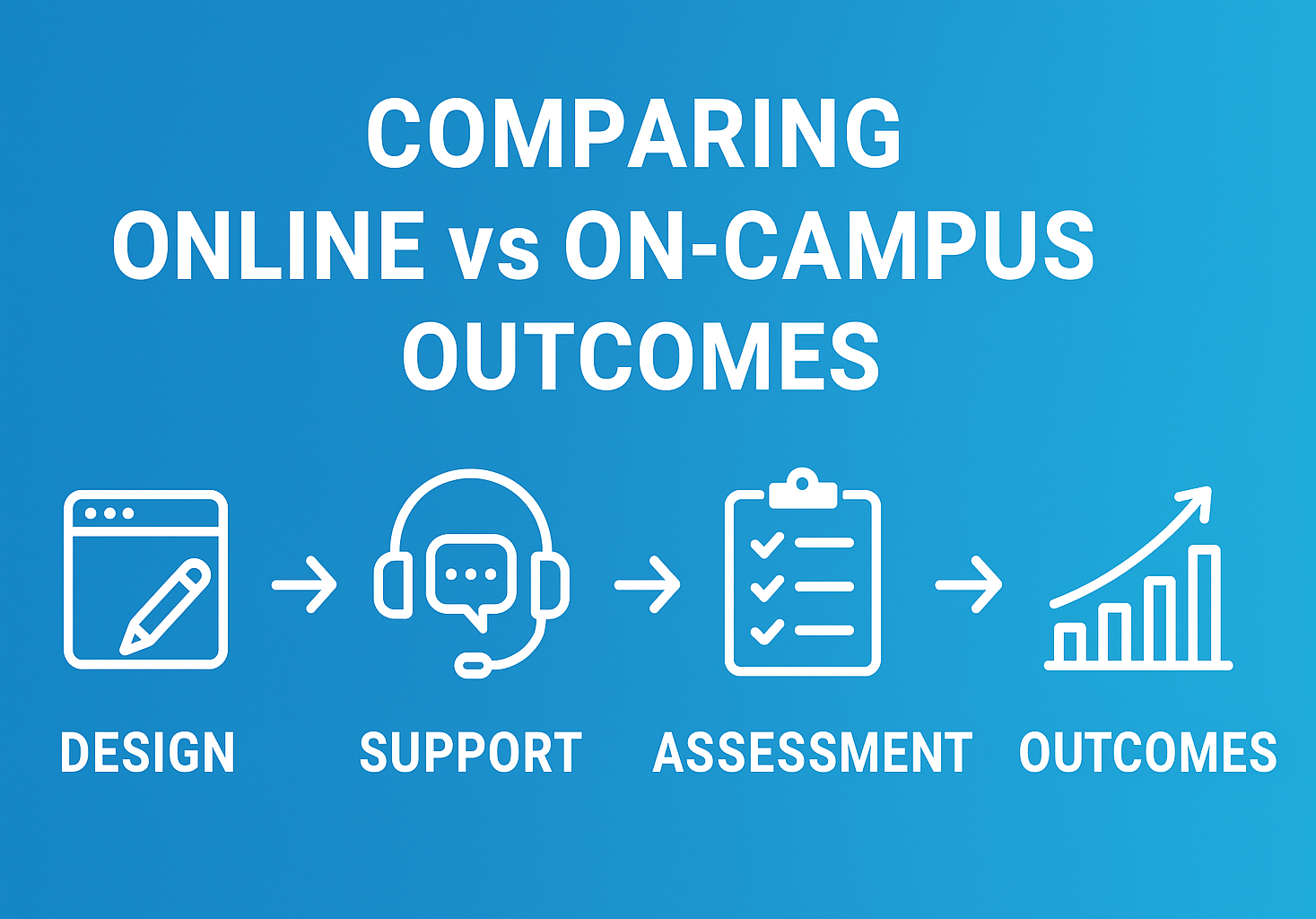
Comparing Online vs On-Campus Outcomes

What evidence from the Middle East shows (and what it means for students & universities)

As online and hybrid degrees become permanent fixtures across Middle Eastern higher education, a practical question keeps coming up: do remote programs produce the same student outcomes as on-campus programs? Short answer: it depends — on program design, student supports, assessment practice and the subject area — and the regional evidence shows both successes and clear caveats. Below, I synthesize regional findings, summarize measurable outcome differences (completion, learning gains, employability, student satisfaction), and give evidence-based recommendations for students and institutions.


Quick headline findings (TL;DR)

  • Well-designed hybrid programs in the region show positive academic effects versus emergency online delivery. 
  • Student preferences are mixed: many learners appreciate online flexibility but still value in-person classes for labs, interaction and campus life. Large student surveys in regional open universities reflect this split. 
  • Completion/attrition rates for distance courses vary — some regional providers report significant non-completion that’s tied to age, prior experience and support mechanisms. (Example: reported 26% non-completion in an AOU sample.) 
  • Practical training (labs, clinicals, fieldwork) remains a challenge online; virtual labs and simulations help learning gains but don’t always fully replace in-person practice. Evidence from virtual-lab vendors and academic reviews shows improved conceptual learning and reduced failure rates when simulations are used alongside hands-on experiences. 


Evidence & what it tells us

1) Academic performance and learning gains

Meta-analysis and regional studies indicate that hybrid and well-structured online courses can match or exceed face-to-face outcomes — provided they include active learning, meaningful assessments and good instructor training. A UAE meta-analysis of hybrid learning summarized positive effects on academic success when prior studies are aggregated, suggesting hybrid designs outperform emergency remote teaching models.

What this means: the mode (online vs in-person) matters far less than the design. Online courses that are simply lecture recordings often underperform; courses that incorporate interactive activities, formative feedback and scaffolded capstones show stronger outcomes.

2) Completion, retention and equity

Regional open/university distance-education data show non-completion remains a serious risk in many online offerings. One institutional study found a ~26% non-completion rate in some online courses, with younger students more likely to drop out — pointing to motivation, digital literacy and time-management as drivers.

At the same time, broader UN reporting and regional analyses emphasize that online expansion increased access (geographic reach, working learners) but also exposed inequalities (connectivity, device access, and uneven faculty capacity), which affect who completes and who benefits.

3) Student experience and satisfaction

Large-sample surveys from regional institutions (for example, across Arab Open University students) show split preferences: some learners prefer online for flexibility and cost, while many still prefer in-person for engagement and hands-on learning. These mixed preferences underline the need for choice and well-supported blended options.

4) Practical & lab-based disciplines

For laboratory and clinical training, virtual labs and simulations substantially improve conceptual understanding and reduce novice error rates — multiple vendor studies and independent reviews document measurable learning gains when simulations are paired with good pedagogy. That said, advanced tactile skills and certain high-stakes procedures typically still require supervised, in-person training and assessment.


Why outcomes differ — key drivers to watch

  1. Instructional design quality: active learning, scaffolded projects, and continuous feedback are essential. Poorly designed online courses produce poor outcomes regardless of subject. 
  2. Student supports: advising, tech help, time-management coaching and mental-health services improve retention and success. 
  3. Assessment integrity & authenticity: proctored exams, project-based assessments, and employer-linked capstones better predict workplace readiness than multiple-choice tests. 
  4. Access & equity: broadband, device access, and a quiet study environment remain major factors that shape who does well online. Regional SDG/education reviews highlight this divide. 
  5. Field/discipline: STEM labs, clinical programs and performance arts require in-person experiences that online tools can supplement but rarely fully replace. 

Practical guidance — for students

  • Match program type to goals. If your aim is career entry in a highly practical field (medicine, lab science, aviation), prioritize degrees with in-person practicum or clearly defined, accredited simulated-to-in-person pathways. 
  • Check support services. Before you enroll, verify 24/7 tech help, academic advising, and career services for online cohorts. Programs that publish these supports have better retention. 
  • Prefer project-based assessment. Stackable capstones, employer projects or graded portfolios generally translate better to jobs than passive completion badges. 
  • Ask about completion statistics. Good providers report cohort completion and employment outcomes — ask for them. 


For universities & program designers

  • Invest in instructional design teams and faculty training for online pedagogy. Hybrid formats often deliver the best of both worlds. 
  • Use virtual labs and analytics to improve engagement and measure concept mastery, but preserve in-person assessments where safety or hands-on proficiency is required.
  • Monitor equity indicators (device access, broadband), and provide loaner devices, low-bandwidth alternatives and targeted scholarships. Regional reviews stress the importance of minimizing the digital divide.

Conclusion

Remote and on-campus programs can both produce strong outcomes in the Middle East — but success is conditional. Programs that combine strong instructional design, robust student supports, authentic assessment, and equitable access usually match or surpass on-campus outcomes. Conversely, online offerings that were hurriedly built or that lack student supports tend to show higher attrition and lower satisfaction.